What You’ll Need
Before you touch a single outreach email, get this stuff lined up. Skipping it just means backtracking later.
- Google Search Console access — verified on your domain, not just a subfolder.
- GA4 installed with at least one conversion event set up for service leads or form fills.
- A free backlink checker (Ahrefs’ free version, Moz Link Explorer, or Ubersuggest all work) plus a paid tool if your budget allows — you’ll want deeper referring-domain data eventually.
- Keyword Planner access through a Google Ads account, even if you’re not running PPC.
- An SEO audit tool like Screaming Frog or Sitebulb to catch crawl and canonical issues.
- Backend access to your CMS (WordPress, Shopify, whatever you’re on) to edit robots.txt, meta tags, and header structure.
- A spreadsheet or CRM to track outreach contacts, replies, and links earned — a plain Google Sheet is fine to start.
- Basic writing skills or a content writer — link-worthy pages don’t build themselves.
- Time: plan on 3-4 hours a week for outreach and audits, spread across 60-90 days before you’ll see real ranking movement.
Don’t have all of this in-house?
That’s usually the point where founders start pricing out an seo marketing agency instead of doing it solo. Either path works — just don’t skip the audit step first.
Ninety-three percent of local service businesses that rank on page one share one thing in common: a backlink profile built on purpose, not luck. Most founders treat seo engine optimization like a checklist — sprinkle some keywords, submit a sitemap, call it done. That’s not how rankings actually move for plumbers, HVAC companies, garage door repair shops, or any service business competing on Google Maps and organic search at the same time.
Here’s what most people miss: backlinks don’t work in isolation. A link from a trade association or industry directory only carries weight if your technical foundation lets Google crawl and trust the page it’s pointing to. Broken canonical tags, a messy robots.txt file, or thin content on the linked page can quietly waste the equity you just earned. That’s the gap between businesses that see phones ringing within 60 days and ones still wondering why their rankings won’t budge after a year of guest posts.
So what does that actually look like in practice? It means treating link building as one piece of a four-pillar structure — technical, on-page, content, and off-page — instead of a bolt-on tactic. Skip the pillar-thinking and you’ll build links that never get indexed, or worse, links that trip a spam filter because your anchor text is all keyword, no nuance.
No filler. Just the steps that separate agencies that print results from ones that just publish and hope.
What You’ll Achieve With This Backlink-Focused SEO Framework
Picture a local HVAC company stuck on page 3 for “AC repair” despite a clean site and solid content. The missing piece? Backlinks. This is where a proper seo engine optimization framework earns its keep — it treats link building as one of four pillars alongside technical health, content, and on-page structure, not an afterthought. By the end of this guide, you’ll have a repeatable process for finding link opportunities, vetting them, and tracking whether they actually move rankings.
The goal isn’t just “more links.” It’s links from relevant, trusted sources that Google reads as votes of confidence for your local service pages. Get this right, and you’ll see movement in Maps rankings and organic search within 60-90 days.
Prerequisites: Access to Google Search Console, GA4, and Your Website Backend
You’ll need admin access to Search Console — GA4 before starting — these track which pages already earn links and where traffic is stalling. Backend access matters too, since you’ll be adding schema, fixing redirects, and updating internal links as new backlinks come in.
Tools You’ll Need: Free and Paid Backlink Checkers, Keyword Planner, SEO Audit Software
Grab a free backlink checker for quick audits, a paid one (Ahrefs or Semrush) for deeper competitor gaps, plus Keyword Planner — audit software to prioritize which pages deserve outreach first.
Step 1: Audit Your Current Backlink Profile Before Building New Links
Most sites chasing rankings skip this step entirely — and it costs them. Before you send a single outreach email, you need to know what’s already pointing at your domain. A solid backlink strategy inside any search engine optimization and marketing plan starts with cleaning house, not building new. Old links from spammy directories or link farms can quietly drag down rankings for years.
Using a Free Backlink Checker to Find Toxic Links
Run your domain through a free backlink checker (Ahrefs’ free version and Google Search Console both work fine). Look for spikes in referring domains that don’t match your niche. Flag anything from gambling, pharma, or link-farm sites. Then build a disavow list. It’s tedious. But skipping it means new links get built on a shaky foundation.
Reading Domain Authority and Referring Domain Scores Correctly
Domain authority isn’t a Google metric — it’s a third-party score, and it’s often misread. What matters more: the number of unique referring domains, not total backlinks. Ten links from ten different sites beat 100 links from one spam network. Every time.
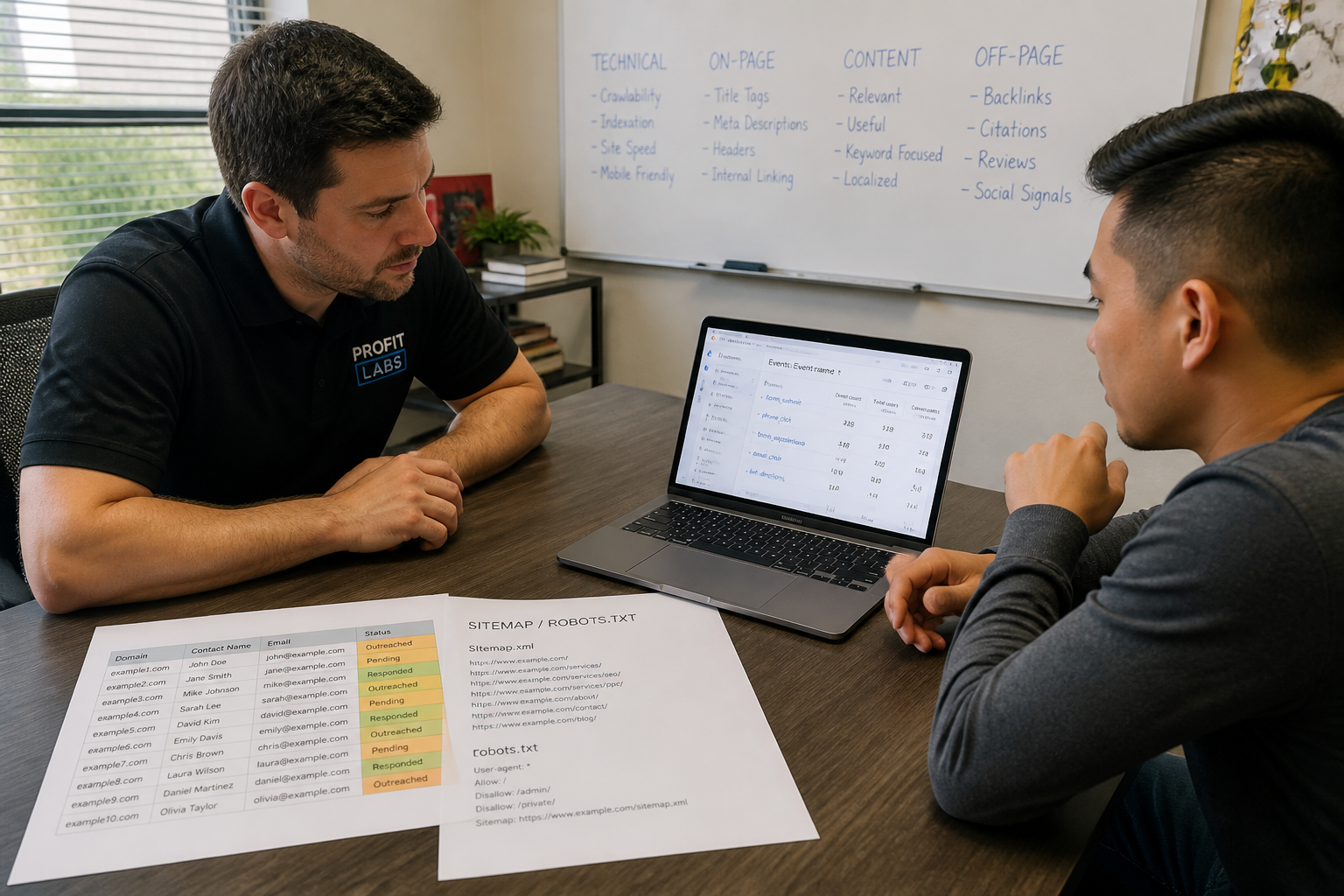
Step 2: Map the Four Pillars — Technical, On-Page, Content, and Off-Page SEO
Which pillar is your site neglecting right now?
Most local service businesses lean on one or two and ignore the rest. Technical SEO covers crawling and indexing — site speed, mobile usability, structured data. On-page SEO handles keyword placement in titles, headers, and body copy. Content answers what customers actually search for. Off-page builds trust signals outside your site. Skip one, and the whole structure wobbles.
Where Backlink Strategy Fits Inside the Off-Page Pillar
Backlinks are the clearest ranking signal Google still weighs heavily. Local directories, industry partnerships, and press mentions all feed this pillar. Not every business builds these efficiently in-house — that’s usually where a search engine optimization services company earns its fee, chasing links your team doesn’t have time for.
Why Local Service Businesses Need a Different Pillar Weighting
A plumber ranking for “emergency repair near me” doesn’t need the same content depth as a SaaS blog. Local rankings lean harder on off-page trust (reviews, citations, backlinks) — technical basics (map pack eligibility, page speed). Content matters, but it’s supporting — not the main driver. Weight accordingly.
Step 3: Fix Technical Foundations So Links Actually Pass Value
Here’s a number that should bother you: roughly 30% of link equity gets wasted on sites with broken canonicalization or blocked crawl paths, according to crawl audits run across mid-size service sites. Earning backlinks means nothing if Google can’t crawl the page they point to. That’s the technical foundation piece most agencies skip when they jump straight to outreach.
Robots.txt and XML Sitemap Checks Before Outreach
Before you send a single pitch email, check your robots.txt file. A misconfigured line can block your money pages from crawlers entirely — it happens more than you’d think. Submit a clean XML sitemap through Google Search Console so new links get discovered fast. Without this step, earned links sit unindexed for weeks.
Canonicalization and Duplicate Content Issues That Waste Link Equity
Duplicate URLs split your ranking signals across multiple versions of the same page. Fix canonical tags so link authority consolidates onto one target. And here’s the thing — smart content marketing for link building only works if the destination page is canonically clean. Otherwise you’re pouring water into a cracked bucket, and every backlink you earn leaks value instead of compounding it.
Step 4: Optimize On-Page Elements to Support Incoming Links
Here’s a myth worth killing: backlinks do the heavy lifting and your on-page setup barely matters. Wrong. A link pointing to a page with weak structure is like handing someone a gift card to a store that’s closed. Google follows the link, hits your page, and if the content and structure don’t confirm relevance fast, that link’s value gets wasted. This is why smart link building services always pair outreach with on-page cleanup — otherwise you’re funding traffic to a dead end.
Header Tags and Internal Link Structure for Service Pages
Each service page needs one clear H1, followed by H2S that break down sub-services or FAQs. Internal links from your homepage and blog posts should point to these service pages using keyword-rich anchor text, not generic phrases like “click here.” This structure helps Google understand hierarchy and passes authority where it counts.
Title and Meta Tag Alignment With Target Keywords
Your title tag should mirror the exact keyword phrase people search for, plus a location or benefit qualifier. Meta descriptions won’t directly boost ranking, but they drive click-through, which indirectly signals relevance back to search engines.
Step 5: Build a Content Hub That Attracts Natural Backlinks
A wheelchair e-commerce brand once sat on 40 blog posts that nobody linked to. Once the team rebuilt them around actual buyer questions instead of city names, links started showing up from mobility forums and health blogs without a single outreach email. That’s the goal here — content that earns links because it’s genuinely useful, not because it mentions a service area.
Creating Location-Agnostic Resource Pages That Earn Links
Skip the “[City] guide” format.
Build comparison pages, cost breakdowns, and troubleshooting guides that work whether the reader is in Ohio or Oregon. These pages get bookmarked, cited, and linked by industry sites — not just local directories.
Repurposing Case Studies Into Linkable Assets
Turn results into data-driven stories.
A 7.89 ROAS case study or a 9,800-keyword ranking win makes for a far stronger link magnet than a generic services page. Journalists and bloggers link to numbers, not sales copy.
Founders often ask whether are seo backlink services worth it for brands chasing faster organic growth — the honest answer is: only if the underlying content deserves the link in the first place.
Step 6: Research Link-Worthy Sites Using Keyword and Competitor Tools
Backlinks still decide who wins local rankings. Full stop. No amount of on-page seo engine optimization work replaces a site that other local pages actually link to — you need a real list of targets, not a wish list.
Using Google Search Operators to Find Guest Post Opportunities
Start with search strings like “[your service] + write for us” or “[your city] blog” + “guest post”. These operators surface sites already publishing local service content, which means faster acceptance and better keyword context around your link.
Layer in “intitle:” and “inurl:” queries to find resource pages listing local vendors — these often accept a listing with one email.
Analyzing Competitor Backlinks With an SEO Audit Tool
Next, run your top three local competitors through an SEO audit tool (Ahrefs, Semrush, or Moz all work). Pull their referring domains, sort by relevance, and note which directories or blogs link to more than one competitor — those are your priority outreach targets.
This kind of research also matters beyond a single campaign. In fact, what backlinking strategies reveal about whether an SEO program can scale is often clearer than ranking data alone — it shows whether your link sources are repeatable or one-off wins.
Step 7: Execute Outreach Campaigns for Service-Based Backlinks
Why do most local service sites still have fewer than 20 backlinks after a year of “SEO work”? Because nobody actually sent the emails. Outreach is the part founders skip — it’s slower than writing meta tags, and it feels awkward. But it’s still the fastest way to build authority for local rankings. Knowing how to create powerful SEO backlinks starts with treating outreach as a weekly habit, not a one-off sprint.
Email Templates That Get Replies From Industry Sites
Skip the generic “great content, let’s collaborate” pitch — site owners delete those instantly. Instead, reference something specific: a broken link on their resources page, a stat that’s outdated, or a gap in their guide. Keep subject lines under 6 words. A 3-sentence email with one clear ask outperforms a 200-word pitch almost every time.
Partnering With Suppliers, Associations, and Trade Directories
Local service businesses sit on an underused goldmine: suppliers, trade associations, and licensing bodies. Ask suppliers for a partner-page mention. Join your trade association’s member directory. These links carry real trust signals because they come from businesses already vetted within your industry.
Step 8: Track Rankings and Referral Traffic in Google Search Console and Analytics
68% of local businesses never check whether their backlinks actually move rankings — they just build links and hope. Don’t be that founder. Google Search Console and GA4 together tell you exactly which links drive traffic and which ones sit dead. Pull the Links report in Search Console monthly and cross-reference new referring domains against ranking shifts for your target keyword.
Setting Up GA4 Goals Tied to Backlink Campaigns
Set up a custom channel group in GA4 labeled “referral – link building” so you can isolate visits coming from guest posts, directory listings, or partner sites. Tie a conversion event to it — form fills, calls, quote requests. If a campaign built 15 links last quarter and referral conversions stayed flat, that’s a signal your anchor text or placement needs work. Founders who skip this step often can’t tell which seo services spend is actually paying off.
Reading the Performance Report for Keyword Movement
Check the Performance report weekly for the first two months after a link push, then monthly after that. Look at impressions before clicks — rising impressions usually mean Google’s testing your page for new queries. Average position dropping from 14 to 8 within six weeks is a realistic outcome from a focused local link push. Flat numbers past 90 days? Time to rebuild the backlink target list.
Step 9: Prioritize Which Backlink Strategy Matches Your Search Intent
Here’s a myth worth killing: more backlinks always win. Not true. A single link from a directly relevant, high-intent page beats ten generic ones — every time. For local service brands, backlink strategy isn’t a numbers game. It’s a matching game between the link source and what a searcher actually wants to do next.
Commercial Intent Keywords vs Informational Link Bait
Commercial intent keywords (think “emergency plumber near me”) need links from pages that scream credibility — review sites, industry directories, local news mentions. Informational link bait, on the other hand — guides, calculators, checklists — earns links naturally from blogs and forums. Mixing these up wastes budget. If you’re unsure which bucket a link source falls into, many link building companies can help you audit and sort them; check out link building companies for a rundown of how that process works.
Matching Anchor Text to Buyer Journey Stage
Early-stage visitors respond to branded or informational anchors. Bottom-of-funnel pages deserve exact-match or service-specific anchors tied to conversion pages. Get this wrong, and Google may flag over-optimized anchor patterns instead of rewarding relevance.
Step 10: Scale What Works With a Repeatable Monthly Process
Picture a plumbing company that landed one guest post in March and watched local rankings jump for three keywords by May. That’s the moment most owners realize backlink building isn’t a one-off task — it’s a monthly habit. Once a tactic proves itself, the job is to repeat it on a schedule, not chase something new every quarter.
Building a Backlink Calendar Alongside Blog Content
Pair link outreach with your content calendar. If you’re publishing two blog posts a month, plan one outreach push per post — local business directories, industry roundups, or partner sites. Track domain, anchor text, and placement date in a simple spreadsheet. This turns backlink strategies into a system, not guesswork, and gives you data to compare against ranking movement in Search Console.
When to Bring in an SEO Marketing Agency vs DIY
DIY works fine at 2-3 links a month. Once you’re aiming for 10+ quality placements monthly, plus technical audits and content production, most founders hit a wall. That’s when a seo marketing agency earns its keep — Profit Labs, for example, layers link outreach into broader seo engine optimization work so nothing runs in isolation.
Common Mistakes to Avoid When Building Backlinks for Local Service Rankings
Most backlink campaigns fail before they start.
Founders chase volume instead of quality — rankings stall no matter how much content or seo engine optimization work happens on-page.
Buying Links From Low-Quality Directories
Paid links from spammy directories rarely help — and often hurt. Google’s algorithms flag unnatural link patterns fast, especially ones tied to keyword-stuffed anchors or irrelevant niches. A local plumbing company buying links from a gambling directory sends a mismatch signal that search engines penalize.
- Skip link farms and “guaranteed backlink” packages
- Verify domain relevance before accepting any placement
- Prioritize sites with actual traffic and editorial standards
Ignoring Anchor Text Diversity and Over-Optimization Penalties
Here’s the thing: using the exact same keyword phrase in every anchor text looks robotic to Google’s ranking systems. Mix branded anchors, naked URLs, and natural phrases like “click here” alongside targeted terms.
A healthy backlink profile mirrors how people actually link — messy, varied, unforced. Run a quick audit using a free backlink checker tool to spot over-optimized patterns before they trigger a manual penalty.
How to Verify Your Backlink Strategy Is Working
How do you know your link building actually moved the needle instead of just sitting in a spreadsheet? Track it. Don’t guess. Backlinks tied to real service pages should show up in Google Search Console within a few weeks — check the Links report and cross-reference with your ranking tool of choice.
Checking Ranking Movement 30, 60, and 90 Days Out
Set three checkpoints. At 30 days, look for indexing and minor position shifts on target keywords. At 60 days, you want to see movement into page one or two for local service terms — things like “AC repair near me” or category-specific queries. By 90 days, rankings should stabilize higher than baseline. No movement by day 90? Something’s broken — the pages, the anchors, or the sites linking to you.
Confirming Referring Domains Grow Without Toxic Spikes
Pull a referring domains report monthly. Growth should be gradual — 5 to 15 new domains a month is normal for most local service sites, not 200 overnight. A sudden spike usually means spammy directories or a bad link package someone sold you. Use Search Console’s disavow tool if toxic domains show up, and keep a running log so you can spot patterns before they hurt rankings.
How-To FAQ
What is SEO engine optimization?
It’s the practice of shaping a website so search engines can find it, understand it, and rank it for relevant queries. For local service businesses, that means technical setup, on-page content, and links working together — not just one piece in isolation. Skip the backlink layer and the other three pillars lose most of their punch.
How long does a backlink strategy take to show ranking movement?
Most sites see early signals within 30 days and real ranking shifts by 60 to 90 days. Referring domains need time to get crawled and indexed before Google credits them. If you’re chasing overnight jumps, you’re chasing the wrong tactic — this is a compounding process, not a switch you flip.
Is it safe to buy backlinks for a local service site?
No — buying links from low-quality directories or link farms is one of the fastest ways to trigger a manual penalty. Google’s guidelines on link schemes are explicit about this. Stick to earned links from trade associations, suppliers, and legitimate industry publications instead.
What if my referring domains grow but rankings don’t move?
Check your anchor text distribution and your technical foundation first. A spike in referring domains with flat rankings usually means either over-optimized anchors (too many exact-match phrases) or a canonicalization issue eating your link equity before it reaches the right page. Run an audit before adding more links.
Do I need an SEO marketing agency, or can I run this myself?
You can DIY this if you have a few hours a week and patience for outreach — otherwise, an agency speeds it up. Solo founders often manage the audit and on-page fixes fine on their own. Outreach at scale, though, is where most people stall out and where a dedicated team earns its keep.
How many backlinks does a local service business actually need?
There’s no fixed number — quality and relevance matter more than volume. Ten links from respected trade sites will outperform 200 links from spammy directories every time. Focus on steady, natural growth month over month instead of hitting an arbitrary count.
Four pillars. One goal: rankings that hold up under pressure. That’s what proper seo engine optimization looks like when it’s built right — technical fixes done first, on-page elements tightened second, content built to earn links on its own merit, and outreach that targets sites your customers actually trust. Skip the audit step and every backlink after it loses value. That’s the part most local service businesses get backward.
Rankings won’t move overnight, and anyone promising that is selling something. But 30, 60, 90 days out, a founder who tracked referring domains and kept anchor text natural will see the difference — steady movement instead of a spike-and-crash pattern. The businesses that win aren’t the ones with the most links. They’re the ones with the right links, built on a foundation that doesn’t crack.
Pull up Search Console this week. Audit what’s already pointing at your site. Then decide honestly whether it’s a DIY project or one worth handing to a team that’s done this since 2013 — Profit Labs™ can run that audit for you and show exactly where the gaps sit.