What You’ll Need
Before you start blending SEO with paid ads, get these pieces in place. Skipping this step is the fastest way to waste a month chasing numbers nobody trusts.
- Google Analytics 4 access for both organic and paid traffic reporting
- Google Search Console set up and verified on the domain
- Ad account access (Google Ads, Meta, or whichever platforms you run) with at least 60-90 days of history
- A keyword research tool (Ahrefs, Semrush, or similar) to compare organic rankings against paid keyword targets
- A shared spreadsheet or dashboard where SEO and PPC data can live side by side
- Current SEO service scope — know what’s already being done (content, technical fixes, link building) before you try to align it
- Someone who owns both channels — either an internal lead or an agency partner who can speak both languages
- Landing page and content calendar access so you can match organic topics to ad copy
- Roughly 2-3 hours a week for the first month to audit, compare, and reallocate; after that, plan on a monthly check-in of about an hour
That’s it. Nothing exotic — just access, data, and a willingness to stop treating SEO and paid ads like they’re fighting for the same budget.
Two budgets, one client, zero communication between them. That’s how most agencies run SEO and paid ads — as separate line items fighting for credit instead of working the same account. It’s expensive, and it’s slow.
Here’s what most people miss: seo for agencies isn’t a bolt-on service you sell alongside PPC management. It’s the other half of the same growth engine, and when the two channels actually talk to each other, clients see cheaper clicks, better Quality Scores, and organic rankings that climb faster because the ad data already told you which keywords convert.
The honest answer is that most agencies never build this bridge. They run Google Ads in one dashboard, hand SEO off to a different specialist (or a white label partner), and hope the monthly report looks coherent. It rarely does. Meanwhile the client — who just wants revenue, not two disconnected charts — starts asking why they’re paying twice for the same keyword real estate.
Realistically, fixing this doesn’t require a bigger team or a new tool stack. It requires a process: audit both channels together, find where they overlap, and let the data from each one sharpen the other. Paid ads reveal buyer intent within days. Organic content compounds that intent into rankings that don’t disappear the moment you pause a campaign.
What You’ll Achieve and What You Need Before You Start
Picture this setup: a client’s PPC campaigns are pulling clicks — the second the ad budget pauses, traffic drops to zero. That’s the exact gap agencies fill when they pair paid media with seo for agencies — one channel buys attention now, the other builds a foundation that keeps paying off after the budget runs dry.
The Result: A Combined SEO and PPC Engine, Not Two Separate Budgets
By the end of this process, you’ll have a shared keyword list, unified reporting, and a client dashboard showing how organic and paid work together instead of competing for credit. No more silos. No more two account managers fighting over the same conversion.
Tools and Access You Need Before Starting (GA4, Search Console, Ad Accounts)
Before touching strategy, get access locked down. You’ll need:
- GA4 with conversion events already mapped
- Google Search Console verified on the domain
- Admin access to the client’s ad accounts (Google Ads, Meta, or both)
- A shared spreadsheet or reporting tool
Skip this step and you’ll spend week three chasing permissions instead of building strategy.
Step 1: Audit Your Current SEO Services and Paid Ad Spend Side by Side
Most agencies never put organic and paid numbers on the same page. That’s the first problem to fix. If you’re offering seo for agencies as a bolt-on service, you need a shared dashboard that shows both channels next to each other — not two separate reports living in two separate tools.
How to Pull Organic and Paid Performance into One Report
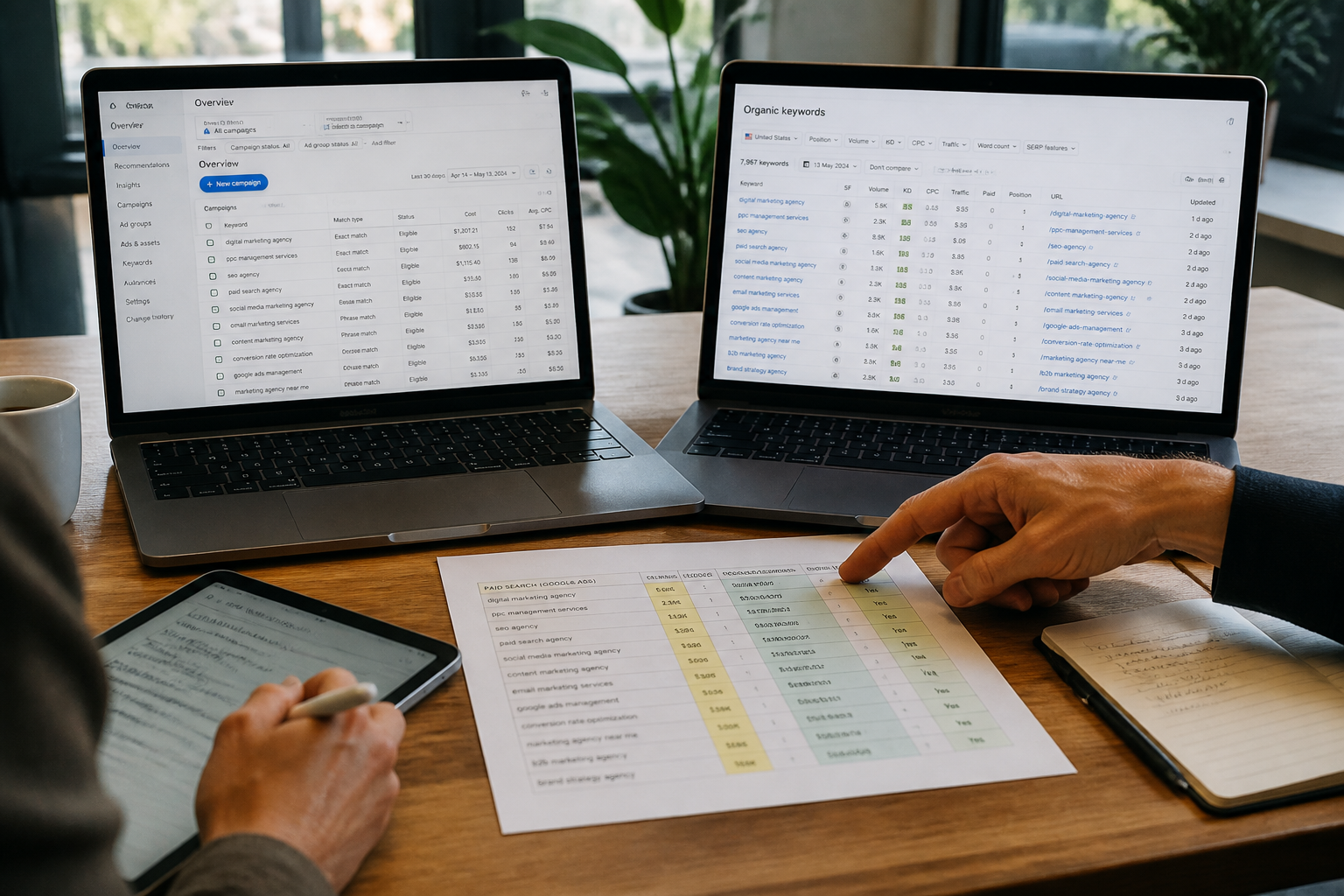
Start by connecting Google Search Console, Google Ads, and your analytics platform into a single spreadsheet or dashboard tool. Pull three metrics minimum: cost-per-click, organic click-through rate, and conversion rate by landing page. Do this weekly, not monthly. If your team is unsure how this fits into broader client work, review how an agency marketing online typically structures reporting across services.
Common Gaps Between SEO Services and PPC Data
Here’s what most agencies miss: paid teams often bid on keywords organic content already ranks for, wasting budget. Others ignore high-performing PPC terms that could become organic content targets. Look for:
- Duplicate keyword targeting across teams
- Landing pages built for ads but never optimized organically
- Content gaps where paid data reveals demand SEO hasn’t touched
Step 2: Identify Keyword Overlap Between Organic Rankings and Paid Campaigns
Are you paying for clicks on terms you already rank #1 for organically? Most agencies never check. That’s money left on the table every single month.
Using a Keyword Research Tool to Spot Duplicate Spend
Pull your Google Ads search terms report and cross-reference it against Search Console impressions. Any keyword ranking top 3 organically that’s also getting paid clicks is a candidate for budget reallocation. A solid seo for agencies workflow builds this cross-check into monthly reporting — not a one-off audit. Use a rank tracker plus your ads dashboard side by side; the overlap usually shows up fast, often 15-20% of paid spend.
When to Let SEO Take Over a Keyword From Paid Ads
If organic holds position 1-3 for 60+ days straight, cut paid spend on that term and redirect budget toward gaps SEO hasn’t reached yet. Branded terms are the easiest wins here — never pay for what you already own. For competitive, high-authority terms, though, don’t pull ads yet; that’s exactly where how to scope link-building for agencies comes into play to lock down the ranking before you touch the paid budget.
Step 3: Build a Shared Content and Landing Page Strategy
Here’s a number that surprises most agency owners: 60% of shoppers click both an organic result and a paid ad from the same brand before converting, according to Google’s own click-behavior studies. That overlap is exactly why seo for agencies and paid campaigns can’t run on separate playbooks. When both channels point to mismatched pages or conflicting offers, you’re burning budget twice for one confused prospect.
Matching Organic Content Topics to High-Converting Ad Copy
Pull your top 10 converting ad headlines and check whether your organic content covers the same pain points. If your ad copy promises “same-day quote,” your ranking blog post shouldn’t bury that offer three scrolls down. Understanding how an SEO agency near me connects rankings calls and revenue helps agencies build content that mirrors the exact language buyers respond to in ads.
Avoiding Duplicate Messaging Across Website and Ad Campaigns
Duplicate, contradictory messaging tanks trust fast. Build a shared messaging doc between your SEO writers and PPC copywriters. Review it monthly. It’s a small habit that quietly protects conversion rates.
Step 4: Set Unified Goals and Success Metrics for Both Channels
Here’s a myth worth killing: rankings and click volume are not success metrics. They’re activity metrics. An agency running seo for agencies alongside paid campaigns needs one scoreboard, not two teams reporting different stats to the same client every month.
Choosing Metrics That Reflect Revenue, Not Just Rankings or Clicks
Pick metrics tied to pipeline: cost per qualified lead, blended conversion rate — revenue per channel. A #1 ranking that doesn’t convert is worthless — same goes for a cheap PPC click that never turns into a sale. Set a shared target, say a $75 cost-per-lead ceiling, and hold both channels accountable to it. This also strengthens build-website-authority-with-high-quality-content efforts, since organic content that earns links and trust tends to lift paid performance too.
Aligning Reporting Cadence Between SEO and PPC Teams
Weekly PPC check-ins and monthly SEO reviews don’t mesh well. Move both teams to a shared bi-weekly cadence with one dashboard. Small businesses especially need this — they can’t afford two consultants pulling in different directions or duplicating spend on the same keywords.
Step 5: Reallocate Budget Based on Combined Channel Performance
Picture this: a client spends $8,000 a month on paid ads and gets 40 leads. Meanwhile, their organic pages, built through six months of seo for agencies work, start pulling in 25 leads for free. That’s the moment to pull up the shared dashboard and make a real call on where next month’s dollars go.
How to Shift Spend From Paid Ads Into Organic SEO Packages
Don’t cut ad spend cold.
Shift it in 10-15% chunks over 60 days while watching cost-per-lead on both sides. If organic keeps closing the gap, move another chunk. Small businesses especially need this staged approach — a sudden budget swing tanks pipeline before SEO fully ramps.
Pricing Considerations When Bundling SEO Services With Ad Management
Bundled pricing works better than stacking separate invoices. A combined package covering content, technical fixes, and paid management usually runs cheaper than buying each service alone, and it forces one team to own the whole result.
- Bundle link building with paid retargeting for compounding authority
- Price by deliverable, not hours, so clients see value clearly
- Review budget splits quarterly, not annually
Agencies partnering with link building agencies often see the fastest organic lift once ad budgets shift.
Step 6: Choose the Right SEO Agency Partner to Execute the Combined Strategy
Most agencies picking a partner for seo for agencies work get this backward — they chase the cheapest bid instead of the best fit. Don’t do that. The right partner treats paid ads and organic as one budget, not two competing departments.
What Professional SEO Companies Should Offer Beyond Rankings
Rankings alone don’t pay bills. A solid partner should hand over conversion data, not just position tracking. Look for a team that also runs a backlink building service for startups so link acquisition scales alongside your paid campaigns instead of stalling once budgets shift. They should also connect content calendars to your PPC keyword lists — that’s where the real efficiency gains show up.
Questions to Ask Before Hiring an SEO Agency in the USA
Before signing anything, ask these:
- How do you report shared wins between paid and organic traffic?
- Can you show a case study with measurable ROAS or organic lift?
- What’s your process for keyword overlap between ads and content?
- Do you offer white label reporting for agency resale?
Honestly, if they can’t answer clearly, keep looking.
Step 7: Coordinate Local SEO and Local Paid Campaigns for Small Businesses
Still running local search and local ads as two separate line items on the invoice? That’s leaving money on the table. A garage door client or an HVAC repair company doesn’t need two disconnected reports — they need one map presence that ads and organic both feed. Case in point: a client hitting the #1 Google Maps spot got there because paid and organic signals matched, not because one channel carried the load.
Aligning Google Business Profile Data With Local Ad Targeting
Pull categories, service areas, and reviews from the Google Business Profile and mirror them in the ad platform’s location targeting. Mismatched radius settings waste budget on clicks that never convert. Keep NAP data identical everywhere — directories, the site, ad extensions — since inconsistency confuses both crawlers and shoppers.
Why Local and National Businesses Need Different Playbooks
A national ecommerce brand chases keyword volume and product-level intent; a local business chases proximity and trust signals. That’s how seo for agencies pairs technical fixes with remarketing across both models, without forcing one strategy onto businesses that need entirely different approaches.
Step 8: Use White Label SEO Services to Scale Without Adding Headcount
Here’s a number that surprises most agency owners: over 60% of digital marketing shops resell some form of white label service rather than build every deliverable in-house. That’s not a shortcut — it’s how lean agencies keep margins healthy while still offering full-scale seo for agencies programs to clients who expect PPC and organic to move together.
How Agencies Resell SEO Packages Under Their Own Brand
White labeling lets an agency package technical audits, content, and links under its own name while a partner does the execution. Clients never see the backend. Your team stays focused on strategy and paid ads coordination, not deliverable production. It’s a practical way to grow revenue without hiring a full SEO department overnight.
What to Look for in a White Label SEO Company
Not all partners perform the same. Look for transparent reporting, month-to-month contracts, and a track record with seo for agencies: scaling backlink programs. Ask for sample reports before signing. A good partner communicates in plain English, hits deadlines, and treats your client relationships like its own.
Step 9: Build an Ecommerce SEO and Paid Ads Workflow for Product Pages
Here’s a myth worth killing: organic and Shopping ads don’t compete for the same budget or the same customer. They compete for the same real estate on the results page, and agencies that treat them as separate departments leave money on the table. Good seo for agencies that work on ecommerce accounts means the product feed and the organic listing say the same thing, at the same time, to the same shopper.
Matching Organic Product Listings With Shopping Ad Campaigns
Pull your top 50 revenue-driving SKUs and check title alignment between the Shopping feed and the on-page H1. Mismatched pricing, missing size variants, or thin descriptions confuse both Google and buyers. Strengthen the organic side with review schema, clear stock status, and internal links from category pages — and if backlinks to those product pages are thin, structured link building packages can close that gap fast.
Fixing Conversion Leaks Before Scaling Ad Spend
Don’t pour more budget into a leaky page.
Check load speed, checkout friction, and mobile layout first. A 2-second delay can cut conversions by double digits. Fix the leak, then scale — not the other way around.
Step 10: Track Combined ROI Across Organic and Paid Channels
Picture a client who runs a $6,000/month PPC budget alongside an SEO retainer. Six months in, organic traffic climbs 40% and paid conversions hold steady — but the client’s finance team asks a blunt question: which channel actually drove the new revenue? That’s the moment reporting either builds trust or blows the whole relationship up.
Setting Up Attribution Models That Credit Both Channels Fairly
Multi-touch attribution beats last-click every time when you’re running seo for agencies alongside paid campaigns. A visitor might discover a brand through an organic blog post, then convert two weeks later after clicking a retargeting ad. Give credit to both touches, not just the closer. Google Analytics 4’s data-driven attribution model handles this reasonably well for most small business accounts.
Reporting Templates Clients Actually Understand
Skip the jargon-heavy dashboards. Clients want three numbers: total leads, blended cost per lead, and channel-by-channel trend lines. Add a section showing link-building progress, since backlinks compound organic gains over time — walk clients through how to create powerful SEO backlinks to justify the long-term spend. Simple, honest reporting keeps retainers renewed.
Common Mistakes to Avoid When Aligning SEO and Paid Ads
Most agencies get this wrong. They set up SEO and PPC as two separate departments fighting for the same budget line instead of one connected system built around growth.
Treating SEO and PPC as Competing Budgets Instead of One Strategy
When a client asks for seo for agencies pricing, the conversation often turns into SEO versus PPC — as if one has to lose. That’s the wrong frame. A small business running paid ads for quick leads while organic content builds authority in the background isn’t wasting money; it’s compounding it. Agencies that pit these budgets against each other end up cutting the channel that takes longer to show results — usually SEO — right before it starts paying off.
Ignoring Organic Data When Setting Paid Campaign Targets
Here’s what most people miss: organic search data tells you exactly which keywords convert before you spend a dollar on ads. Skipping that step means guessing at targets instead of using real numbers. Pull your top-performing organic pages, check which terms already rank, and build paid campaigns around proven demand — not assumptions. That’s how professional companies keep cost-per-click down while scaling faster.
How to Choose the Best SEO Agency for This Combined Approach
How do you pick a partner who can actually run SEO for agencies alongside a live PPC account without the two teams tripping over each other? Start by asking who owns the keyword strategy. If SEO and paid ads sit in separate silos with no shared reporting, you’ll pay twice for the same clicks.
Comparing Affordable SEO Services Against Full-Service Agencies
Affordable SEO services often mean templated packages — decent for a small business testing the waters, but thin when you need organic and paid working from one plan. Full-service agencies (Profit Labs™ included) build campaigns where content, on-page work, and ad spend inform each other. Ask for a sample of how they’ve merged the two before signing anything.
Red Flags in Pricing, Contracts, and Reporting
Watch for these warning signs:
- Vague pricing with no breakdown between SEO and PPC line items
- Long contracts with no exit clause
- Reporting that only shows rankings, not revenue or ROAS
- No mention of Google Analytics or Search Console access
If an agency can’t explain its reporting in plain English, that’s your answer.
Next Steps: Verifying Your SEO and Paid Ads Strategy Is Working
72% of buyers research a company across at least three channels before ever filling out a form — meaning your SEO and paid ads can’t be judged in isolation. If you’re only checking rankings or only checking cost-per-click, you’re missing the bigger picture of how these channels actually work together.
A 30-Day Checklist to Confirm Alignment Is Paying Off
- Compare organic and paid landing page conversion rates side by side — a gap wider than 15% signals a messaging mismatch.
- Check whether branded search volume rose after paid campaigns launched. That’s a sign your ads are feeding SEO visibility, not competing with it.
- Pull cost-per-lead by channel and blend it. A good agency or consultant should show you the combined number, not just the flattering one.
- Review whether paid ad copy and organic content are using the same keyword targets.
When to Revisit Your Strategy and Adjust Budget Again
Revisit every quarter, minimum. If organic rankings climb and paid CPCs on those same terms drop, shift budget toward new keyword gaps. If a campaign underperforms two months straight, don’t wait for a full review cycle — pause it and reallocate immediately.
How-To FAQ
How long does it take to align SEO and paid ads for an agency client?
Most agencies see the first signs of alignment within 30 to 45 days, though full budget reallocation usually takes a full quarter. You need at least one reporting cycle of combined data before making real spend decisions — rushing this step is the number one reason blended strategies fail.
Do I need to pause paid ads while building out organic SEO services?
No, and you shouldn’t. Paid ads keep revenue flowing while SEO builds momentum in the background (organic rankings typically take 3-6 months to mature). Pulling ad spend too early leaves a visibility gap that competitors will happily fill.
What’s the biggest mistake agencies make when combining SEO packages with PPC management?
Running both channels off separate keyword lists is the biggest mistake. When your paid team bids on terms your organic content already ranks for on page one, you’re paying for clicks you’d get for free. Pull both keyword sets into one sheet before you touch the budget.
Can small businesses afford to run SEO and paid ads together?
Yes — affordable SEO services paired with a modest ad budget often outperform an all-paid approach over 6 months. Many small business clients start with a lean SEO package (think basic on-page and technical fixes) and a tight local ad budget, then scale whichever channel shows the better cost-per-lead.
Is it risky to shift ad budget into SEO if rankings drop?
It’s only risky if you shift budget blindly without a tracking system in place. Set up GA4 and Search Console before you move a single dollar, and keep a 10-15% paid ad reserve for any keyword where organic rankings slip. That reserve protects lead flow while SEO recovers.
Should agencies use white label SEO services to manage this combined strategy?
White label SEO services make sense when you don’t have in-house technical SEO capacity to match your paid ads team’s pace. A good white label partner delivers reporting under your brand and works off the same combined keyword and content plan, so the client never sees a seam between the two channels.
None of this works if SEO and paid ads keep living in separate spreadsheets, run by separate teams, reporting on separate goals. The agencies that win in 2026 treat keyword overlap, landing pages, and budget allocation as one connected system — not a turf war between channels. Pull organic and paid data into one report. Let winning keywords graduate from paid to organic. Shift spend where the numbers actually point, not where habit says it should go. That’s the whole game with seo for agencies done right: fewer wasted dollars, faster compounding results, and reporting clients can actually understand without a translator.
None of this happens by accident, though. It takes the right partner running the technical work, the content strategy, and the reporting in sync.
Profit Labs has been building that kind of combined engine for agencies and their clients since 2013 — full transparency, plain-English reporting, no guesswork. Book a meeting, walk through a real case study, and see what a properly aligned SEO and PPC strategy could add to your pipeline this quarter.